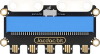
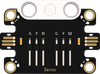
Micro:bit Related ProductsJacdac SeriesJacdac Energy Experiment KitCase 6: Wind Power GenerationOn this pageCase 6: Wind Power GenerationIntroductionTilt the micro:bit V2 board to control the "wind strength" — the greater the tilt angle, the stronger the wind, and the faster the 360° building-block servo drives the wind turbine blades. When the board is held upright (no-wind state), the blades stop rotating. The built-in accelerometer senses the tilt angle and adjusts rotation speed in real time, simulating a wind turbine operating in response to changing wind conditions.Learning ObjectivesLearn about wind turbines and understand the basic principle of converting wind energy into electrical energy.Learn about the micro:bit V2's accelerometer — a MEMS sensor capable of detecting tilt angle and motion state.Understand the difference between gyroscopes and accelerometers and their respective applications in daily life.Learn multi-condition branching (if-else if-else) — categorizing wind levels based on tilt angle and executing different rotation speeds for each level.Understand the important role of wind energy in the history of human energy utilization.Required MaterialsItemImageQuantitymicro:bit V21Jacdac Expansion Board1Jacdac 25cm Connector Cable1Jacdac Servo Module1360° Building-Block Servo1USB Cable1Jacdac Energy Practice Kit Building Blocks1Sensor PrincipleThis case uses the built-in accelerometer of the micro:bit V2 as the sensor. It detects the board's tilt angle (pitch direction) and maps the tilt angle to different wind levels with corresponding servo speeds.Assembly StepsModel PrincipleWind Turbine — Capturing the Energy of the WindA wind turbine consists of three major parts: the tower, blades, and nacelle (housing the generator). The wind pushes the blades to rotate, transmitting rotational kinetic energy through the main shaft to the generator, which uses electromagnetic induction to convert kinetic energy into electrical energy. In simple terms:Wind energy → Blade rotation (kinetic energy) → Gearbox speed change → Generator rotation → Electromagnetic induction → Electrical energyThe faster the blades spin, the greater the generator's power output. A single modern large wind turbine (10 MW) operating at full capacity can generate 10,000 kWh per hour — enough to power an average household for about 3 years.Connection DiagramAs shown below, insert the micro:bit V2 board into the Jacdac expansion board, and connect the servo module to the Jacdac expansion board's edge connector.Programming SoftwareMicrosoft MakeCodeMakeCode ProgrammingStep 1: Adding the Jacdac ExtensionGo to Microsoft MakeCode and click "New Project".Enter a project name in the pop-up window and click "Create".Click "Extensions" in the code drawer.In the pop-up interface, type "Jacdac" and click the search icon, then select the Jacdac software library as shown.Step 2: Connecting the HardwareUse a USB cable to connect the micro:bit V2 board to the computer.Note: If this is the first time running a Jacdac program on the micro:bit V2, please pre-load a blank Jacdac program onto the board first. Otherwise, skip this step.Connect the sensor. MakeCode will automatically detect and simulate it in the simulator area, where sensor status is displayed in real time.Click "ADD BLOCKS" to add the sensor extension module.Note: When connecting a new sensor, repeat the "click 'ADD BLOCKS'" workflow once.Write the Program as ShownReference Program Linkhttps://makecode.microbit.org/_5uu7PU2ojFTcYou can also download the program directly from the webpage below. Once downloaded, you can start running the program.ResultWhen the micro:bit V2 board is held upright, the servo is stationary — no-wind state. Tilt the board slightly forward (small angle), and the servo rotates at low speed — a gentle breeze. Increase the tilt to a medium angle, and the servo rotates at medium speed — the wind picks up. Tilt it steeply, and the servo rotates at high speed — strong wind incoming. The tilt angle determines the "wind strength" and blade speed in real time.ThinkBesides tilt detection, what other motions can an accelerometer sense? (Hint: shaking, free fall)If you attached the micro:bit to a spinning bicycle wheel, how would the accelerometer readings change?Program LogicTrigger ConditionActionSourceBoard held upright (no tilt)Servo stationary — no-wind statemicro:bit AccelerometerSlight tilt (small angle)Servo rotates at low speed — gentle breezemicro:bit AccelerometerMedium tiltServo rotates at medium speed — wind strengtheningmicro:bit AccelerometerSteep tiltServo rotates at high speed — strong windmicro:bit AccelerometerKnowledge Extension: Wind Energy — A Ten-Thousand-Year Journey from Sailboats to Offshore Wind FarmsI. Wind — Humanity's Earliest "Free Energy"Before coal and oil were discovered, wind and water were the only two forms of natural power that humans could harness at scale. The history of wind energy utilization is almost as long as human civilization itself:PeriodWind Energy ApplicationRepresentative Example~5000 BCEWind-powered sailingAncient Egyptian Nile sailboats~200 BCEWind-powered water liftingPersian (Iranian) vertical-axis windmills7th–13th century CEWindmill drainage & grindingPersian windmills spread westward → European windmills, Chinese vertical-sail windmills12th centuryEuropean windmill proliferationDutch windmills for drainage and land reclamation (see Windmill Case)1887–1888First wind turbine generatorsJames Blyth (Scotland) built one for his holiday home; Charles Brush (USA) built a 12 kW turbine1941First megawatt-class wind turbineSmith-Putnam turbine, Vermont, USA, 1.25 MW1970sOil crisis spurs wind power revivalDenmark leads large-scale deployment1991World's first offshore wind farmVindeby, Denmark — 11 × 450 kW turbines2025Global wind capacity reaches 1,299 GW57 countries built new wind projects; China's installed capacity exceeds 520 GWII. How a Wind Turbine WorksA modern wind turbine consists of the following key components: ┌──────────────────────────────┐ │ Wind Turbine Structure │ └──────────────┬───────────────┘ │ ┌─────────┐ ┌────────┐ ┌───────┴───────┐ ┌──────────┐ │ Blades │ │Nacelle │ │ Tower │ │Foundation│ └────┬────┘ └───┬────┘ └───────────────┘ └──────────┘ │ │ ┌─────┴─────┐ ┌──┴──────────────┐ │Wind pushes│ │Gearbox→Generator│ │rotation │ │Kinetic→Electric │ │Up to 140m+│ │Yaw system→align │ └───────────┘ └─────────────────┘ComponentFunctionInteresting FactBladesCapture wind energy, convert wind kinetic energy into rotational kinetic energyModern blades can exceed 140 meters in length — longer than a football fieldNacelle (housing generator)Convert rotational kinetic energy into electrical energyContains a yaw system that automatically rotates the nacelle to face the windTowerElevates the turbine to capture stronger, more stable winds at altitudeModern tower heights can reach 140 meters — about 50 stories tallFoundationSecurely anchors the entire structureOffshore turbine foundations can weigh thousands of tons — equivalent to a small warshipKey Data: A single 10 MW offshore wind turbine's blades take about 4–5 seconds per rotation, but each rotation generates approximately 15 kWh of electricity. At that rate, one turbine can generate about 40 million kWh annually — enough to power roughly 12,000 Chinese households for an entire year.III. Wind Power — A Vanguard of the Global Energy TransitionKey Data PointValue2025 global new wind installations165 GW, up 40% year-on-year — a historic recordEnd-2025 global cumulative wind capacity~1,299 GW2024 global wind electricity generation2,494 TWh, 8.1% of global electricityWorld's largest wind power countryChina (520 GW, ~40% of global total)World's largest offshore wind farmDogger Bank, UK (planned total capacity 3.6 GW)World's largest single wind turbineMingyang MySE 18.X-20MW (China, already rolled off production line)2024 wind industry employment~1.6 million people globally57 countriesBuilt new wind projects in 2025In 2024, Denmark generated approximately 55% of its electricity from wind power — the highest share globally. Ireland (36%), Uruguay (35%), and Portugal (29%) followed closely. In these countries, one out of every three kilowatt-hours comes from the gift of the wind.IV. The Future of Wind — How Much Potential RemainsProspectDescriptionFloating offshore windTraditional offshore turbines require seabed fixation (water depth < 60 m). Floating turbines can be deployed in deep water (> 60 m), multiplying the accessible wind resource several-fold. Japan, Norway, and Scotland have built demonstration projects.High-altitude wind energyAt 300–500 m altitude, wind speeds are 2–3× higher and more stable than at ground level. Multiple companies are developing tethered kite/drone power generation systems, replacing heavy towers with lightweight tethers.Turbine blade recyclingEarly fiberglass blades were difficult to recycle after decommissioning. From 2025, multiple manufacturers have started introducing recyclable blades whose materials can be reused after retirement.Wind + energy storageWind is intermittent? Pair it with large-scale battery storage or hydrogen production (using surplus wind power for electrolysis to produce hydrogen) to "shave peaks and fill valleys," making wind power available 24/7.According to IEA projections, by 2050, wind and solar together will provide approximately 70% of global electricity. The tiny servo-driven blades you control on the micro:bit today could one day grow into giant rotors over 200 meters in diameter sweeping across the sea surface. The wind keeps blowing — the key is whether we are ready to capture it.

.png)